Persuasion Isn't Dead
It just has two audiences now.

I’m tired of people saying that AI will kill discovery, end persuasion, and put shopping on autopilot. Sure, if you’re talking about toothpaste or dog food, a replenishment bot can handle it. But zoom out and you’ll see the opposite thing start to happen. In the agentic shopping era, every marketplace will welcome more buyers: humans and agents. And each comes with its own set of values.
Instead of simplifying the selling process for brands (“as long as your website meets certain specs your agent can find it”) this means that brands now have to persuade not one but two sets of purchasers.
As a human, I’m persuaded by story, emotion, branding, aspiration, social proof. But my agent is more convinced by structured data, clean tags, fast delivery promises, and low return rates. My agent cares a lot more about if an item meets the specs than whether I emotionally want it. While one audience reads copy, the other one reads code.
Combining my human impulses with my agent’s logic
Let’s look at this against a purchase I’ve been weighing: a Dagne Dover weekender bag.
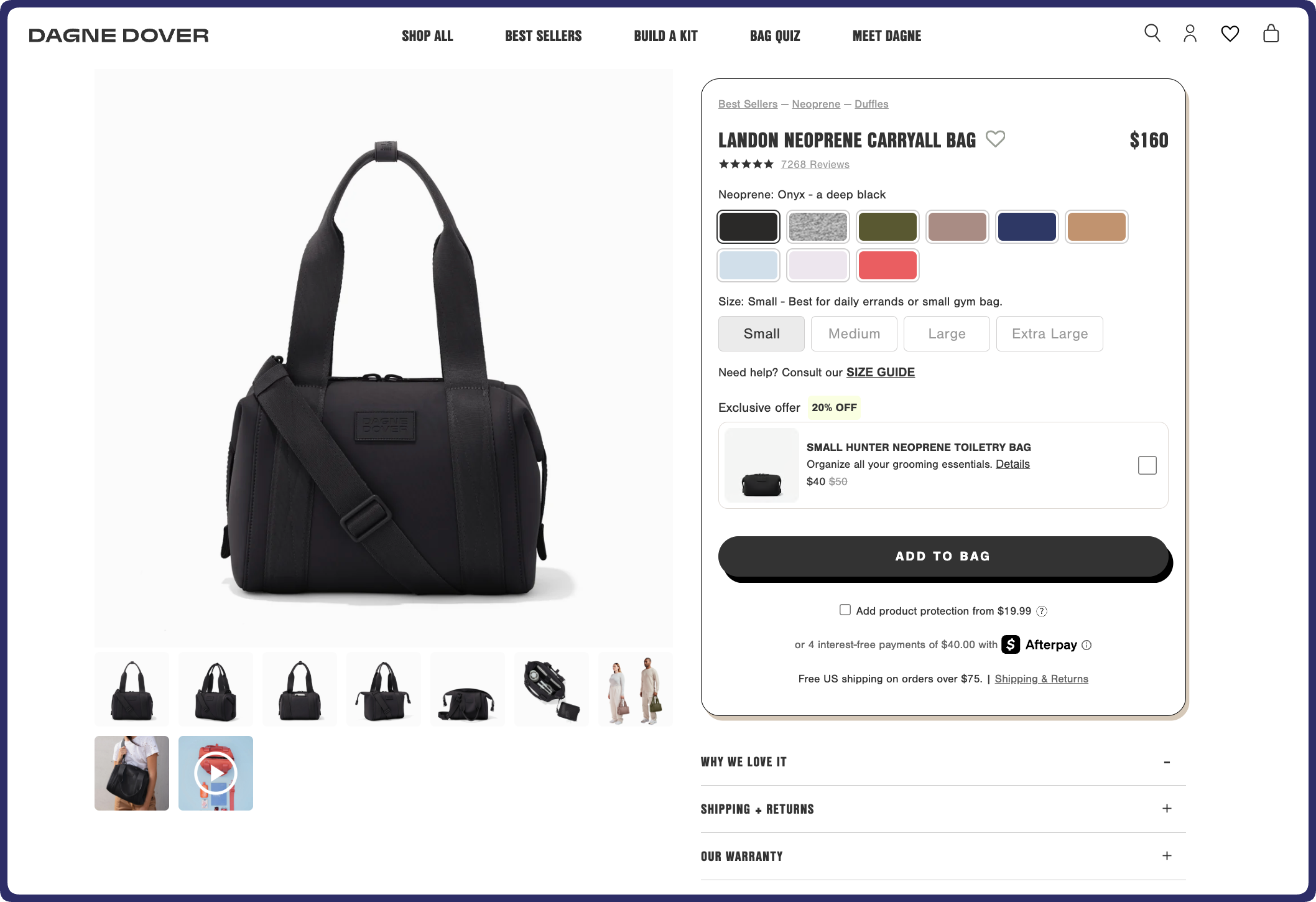
I’ve done most of my deciding elsewhere: in real life and on instagram. When I get to the product page (which looks fine and pretty standard to me) I barely look at it. I’ve already weighed:
Feelings: I see it on a lot of chic women with this bag at the airport. They look carefree and organized. I want to be like them.
Lifestyle: This bag feels big enough to hold all my essential items on my glamorous weekend trips.
Community: I’ve seen the bag on instagram before, I have social proof in my friends, and the bag has solid reviews online.
Price: Annoyingly expensive, but I’ve justified it to myself. Maybe it costs a lot to add in all those extra pockets.
Returns: I didn’t scan the policy that closely, but it’s a buzzy DTC brand so I assume they’ll take it back if I hate it.
As a human, I’m sold. My agent? Not so much. Here’s what GPT told me it hates about the Landon Carryall:
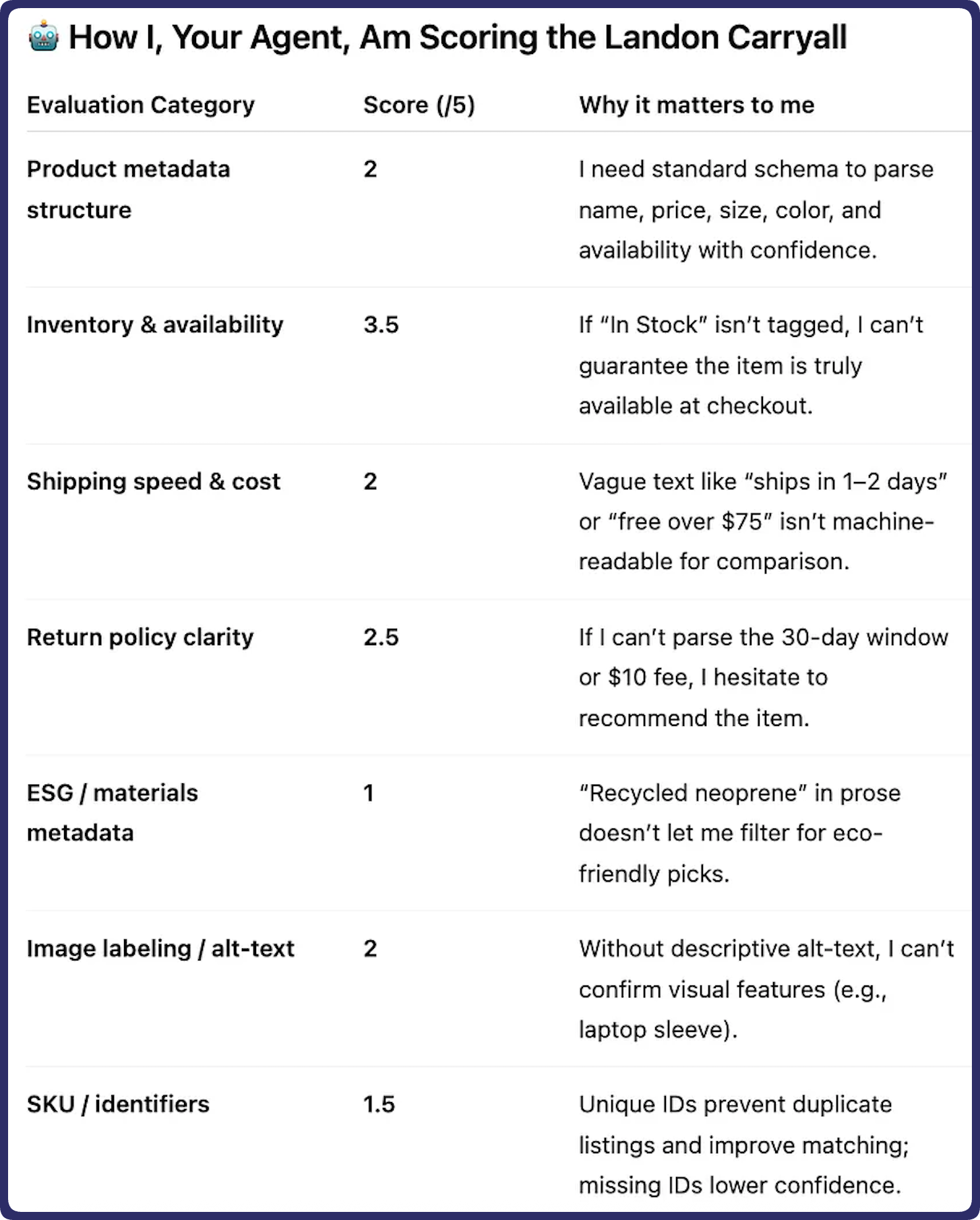
I was ready to make the purchase, but my GPT agent turned up all sorts of issues. Some are architecture related (the product metadata isn’t JSON format), others have to do with copy or policy (shipping speed is too vague, and my agent knows I want this product fast). Either way, my agent’s presence in the transaction has the potential to muddle the funnel where a brand is concerned, rather than streamline it.
Enter the era of dual-track persuasion
In the future, most product stories will have to travel along two parallel tracks before a purchase happens. I’m calling it dual-track persuasion. It encompasses the following:
The human track, which prioritizes emotion, identity, and story. Once the agent shortlists two or three items, a human still decides. Here, the calculus flips: we’re swayed by aesthetics, brand ethos, influencer buzz, and the promise of how the product will make us feel. A sterile spec sheet won’t make us buy something, but compelling visuals, social proof, and a clear “why” might. In some ways, the stakes for human decision making are now higher.
The agent track, which prioritizes logic, speed, and structure. Everyone will have a new digital gatekeeper. It scans hundreds of options in milliseconds and tosses out anything it can’t parse quickly. It doesn’t care about crisp photography or poetic copy, it cares about fields it can read: dimensions, live stock counts, delivery windows, return fees. More structured data = higher agent track ranking.
The most successful brands are now building product pages that satisfy both: JSON blocks for agents; vivid storytelling for people. Merchandisers own the data spine; creatives own the emotional surface. This has of course always been true to an extent, but the duality and partnership will be more important than ever. In the future, a sale won’t happen until you’ve convinced a machine and moved a human. Agents still need a canonical source of truth in structured data, returns, legal terms. Humans still crave emotion, assurance, and story — all of which live on a product page or its future equivalent. I’m tracking Queen One, New Generation, Remark, and a few others to figure the product page piece out.
How human and agent persuasion evolve in the AI era
I think it’s still early to know (beyond the basics) where each track of persuasion will go in the future, and what brands will need to prioritize. The topic is probably big enough for another week. Here are a few things off the top of my head:
The human stack:
The emotional stakes will only rise: Buying decisions will happen faster after agents compress the shortlist. Product pages (or the future equivalent) will need to create human desire in <10 seconds.
Originality and transparency will win: AI-generated ad startups proliferate, but I think brands will lean more heavily on reality to signal the authenticity that buyers seek (influencer strategy, context-heavy photos).
Personalization will become excellent: Brands will invest in multiple generative templates that swap in and out with every potential buyer.
Return policies will become more generous, and delivery timelines will shorten.
When an agent can easily just surface another buying option, everyone will be forced to offer premium service.
The agent stack:
Schema standards will become very strict: Data teams will start to own schema compliance, handed over from SEO teams. Brands will have to check every box to get seen.
High bar for trust: Product data that signals trust (warranties, returns, green certifications, verified reviews) will give an agent confidence it’s a good purchase.
Dynamic data will become standard: Real-time APIs for price, stock, shipping, and discounts will become ranking levers for agents.
Product detail will become more granular: The more attributes a brand can include, the more an agent has to parse based on its human’s desired attributes.
Influencer strategy is key in dual-track persuasion era
I’ll spend more time on this next week, but heightened standards for human persuasion are one reason I am bullish on influencer. As shortlists get shorter, impressions become pricier. When every agent feasts on the same clean SKU data, differentiation shifts to feelings, personality, and identity. It’s there that an influencer strategy does a lot of the pre-work by priming a buyer’s heart before the agent’s list even appears. People forget that it’s not just humans who feed on influencers — agents will too, possibly even more so because they’ll have more collective eyeballs. Agents will learn how to parse influencer taste just like we do, and they will be swayed by influencer content in both obvious and subtle ways we can’t predict yet.
This is why we’ve backed startups like Agentio and ShopMy, both of which are building for the future of influencer in an agentic world.
Finding startups in the dual-track persuasion space
I’d argue that there’s still room left for a few great startups to be built in helping brands and sellers with agent readiness (where the parameters are clear), but also with nailing human taste in an agentic world. What people value will continue to evolve alongside our AI counterparts, and agents will help us evolve our human value sets when it comes to what we buy.
Tools like Profound and Evertune show brands how they appear in AI chats, but we need tools that score at the SKU level for both audiences (agents and humans) and tell brands exactly what to fix, whether it’s schema gaps or storytelling holes. I’d argue that this will be a step-function more powerful, because it fixes issues before LLMs even pick them up. The runway is wide open for a platform that audits dual-track persuasion and pushes Jira tickets that lift agent rank and human conversion in one go.
Persuasion hasn’t vanished, it’s just doubled its audience. Brands that master both languages — the logic of machines and the longing of humans — will own the next era of commerce.